Three times a week we get this message: "We have an €8K budget, we got quotes from 3 Paris agencies — all came back at €25K. We also got a €1,800 offer from a Bangalore agency. We don't know what to do anymore." That frustration illustrates the absurd double standard of the francophone digital market in 2026. This article explains why a third model — the Europe + Africa nearshore agency — is becoming the default path for ambitious SMEs.
TL;DR: Morocco/Tunisia nearshore = same technical quality as Paris, francophone team, ±1h timezone, GDPR-compliant, at 40-60% of Paris/Brussels pricing. It's just math.
The low-cost offshore trap
A South-East Asian or Eastern European offshore agency can ship you a site for €2,000. On paper, unbeatable. In practice, here's what statistically happens on the 100 offshore projects we have audited for clients since 2022.
- Async communication: 5 to 8 hour timezone gap, WhatsApp/Skype exchanges, systematic misunderstandings (tech language → business language).
- English as the only working language: fine for you, blocks your non-English-speaking internal contributors.
- Generic design: resold templates, no visual identity, sites that all look alike.
- Mediocre performance by default: Lighthouse 40-60, no technical SEO, no accessibility audit.
- No post-launch support: 30% of offshore agencies become unreachable 6 months after delivery.
- No GDPR compliance: no DPA, no processing register, non-EU hosting by default.
The hidden cost: 30 to 40% of these projects must be rebuilt within 18 months. The client pays €2,000 + €6,000 rebuild = €8,000. The "low-cost" ends up costing the same as a well-built project from day one.
The Premium France/Belgium agency trap
On the other end, top Paris or Brussels agencies usually deliver solid technical work. The problem lies elsewhere.
- Disproportionate pricing for SMEs: €25,000 to €60,000 for a "standard" corporate showcase.
- Rigid structure: minimum 1 project manager + 1 designer + 1 front-end + 1 back-end dev billed, even on projects where 2 people would suffice.
- Availability: top profiles go to big accounts; juniors often end up executing the SME project.
- Timelines: 12 to 20 weeks for a pro showcase site vs nearshore delivering in 5-8 weeks.
- Over-process: 3 to 5 weekly meetings, minutes, committees that would make sense on a €200K project, not a €15K one.
The nearshore model: neither offshore nor Paris
Nearshore is a model where the team is geographically close to the client but in a country with a lower cost of living. For the European francophone market, Morocco and Tunisia tick every box: native francophone, ±1h timezone, mature tech ecosystem, solid CS university training, GDPR applicable via EU subsidiaries. Here's the comparison on the same project.
| Criterion | Asian offshore | Morocco nearshore | Paris premium |
|---|---|---|---|
| Cost of an 8-page pro showcase | €1,500 – 4,000 | €4,000 – 9,000 | €15,000 – 30,000 |
| Median timeline | 8 – 16 weeks | 4 – 7 weeks | 10 – 16 weeks |
| Timezone | +5 to +8h | ± 1h | Identical |
| Working language | English | French + English | French |
| GDPR compatibility | Hit or miss | Yes (EU hosting available) | Yes (native) |
| Post-launch support | Often non-existent | Standard 30d + optional maintenance | Contractual premium |
| Median technical quality | Low to medium | Good to excellent | Good to excellent |
Morocco nearshore is not a European discount. It's pricing aligned to the geographic zone. A senior developer in Agadir earns very well by Moroccan salary standards. The price differential isn't margin compression — it's the economic gap between Casablanca and Paris.
Why 2026 is the year of francophone nearshore
Three trends converge in 2026 to make this model explode.
- Tech maturity in Morocco and Tunisia: top schools (1337, École Polytechnique de Tunis, EMI Rabat, ENSA Agadir, EMSI) have been training engineers to international standards for 10+ years. Local agencies now employ developers with 5-10 years of experience on modern stacks.
- European SME budget crunch: inflation, lower purchasing power, dwindling digital transformation grants. SMEs are looking for better quality/price ratio without sacrificing seriousness.
- Mature collaborative tools: Figma, Linear, Slack, Notion, GitHub Copilot make physical distance irrelevant. The only factor that matters is timezone — and ±1h is imperceptible.
Use case: French SME wanting to scale
A French B2B consulting SME (12 staff, €2M revenue) wants to rebuild its corporate site and launch a client portal. Budget: €20,000. Paris agency: €45K quote, impossible. Offshore agency: €6K quote, but quality concerns. Morocco nearshore solution: €18K shipped in 9 weeks, OVH France hosting, daily video sync, 60-day post-launch support included. The client signs and gets what they wanted from the start.
Use case: African business wanting to move upmarket
A Dakar-based agribusiness SME wants a website and B2B platform to export to Europe. The challenge: being perceived as a credible partner by French and Belgian buyers, with a UX that doesn't feel like a "10-year-old African site". Morocco nearshore becomes a natural fit: same timezone, francophone, payment methods adapted to the African market (mobile money + Stripe), modern design aligned with European standards.
Why we, CodingArt, are positioned here
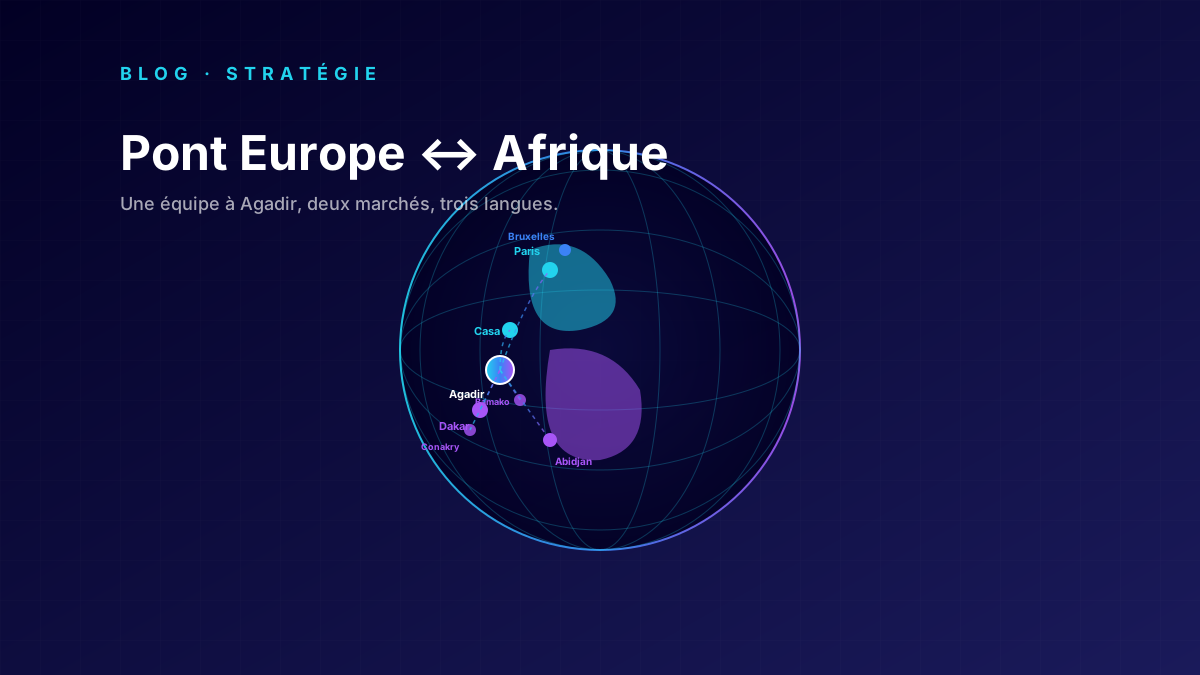
Our team is in Agadir, in the Souss-Massa Technopark. We speak French, English and Arabic. We've delivered 100+ projects for clients in France, Belgium, Switzerland, Morocco, Senegal, Ivory Coast, Guinea and Mali. We use the same tools as Paris or Brussels (Figma, Next.js, Vercel, Linear, GitHub Actions). We offer GDPR-compliant hosting in France or Germany for our European clients, and African datacenters for local projects. Pricing: €4,000-12,000 for a pro showcase, €9,000-30,000 for custom e-commerce, €12,000-40,000 for a native mobile app. It's the bridge we build between the two continents.
Torn between a local agency and us? Ask us for a comparative quote — put it side by side with your best alternative. Our work speaks for itself.
Tags