"We want to launch in 6 weeks, is that possible?" Honest answer: it depends. Not on the site type, but mostly on your ability to provide content, validate mockups fast, and avoid mid-project scope changes. This guide lays out the real 2026 timelines by project type and the levers that make a difference.
TL;DR: a pro showcase site = 3-5 weeks, e-commerce = 6-10 weeks, mobile app = 8-14 weeks, SaaS = 3-9 months. Half the delays come from the client (slow validation, missing content).
The 4 phases of a web project
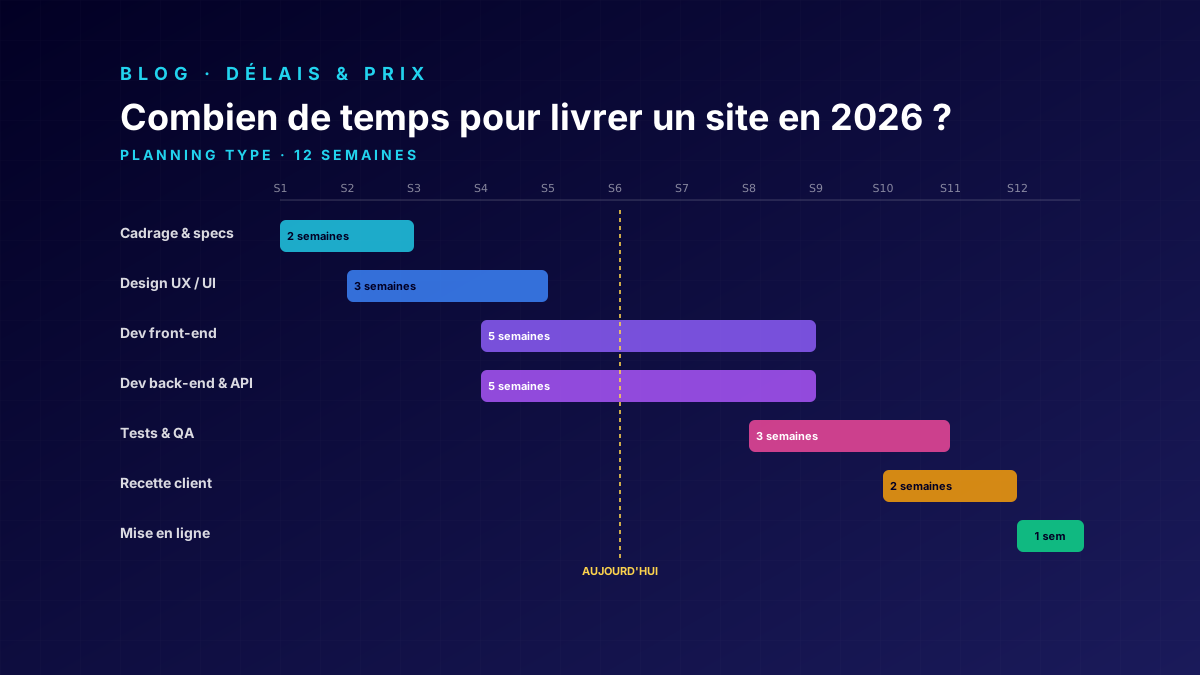
Whatever the site type, a well-run project follows 4 phases with stable proportions. Understanding these phases lets you anticipate where the bottlenecks lie.
| Phase | % of time | Typical deliverables |
|---|---|---|
| 1. Brief & scoping | 10% | Specification, sitemap, detailed quote, schedule |
| 2. UX/UI design | 25% | Wireframes, high-fidelity mockups, interactive prototype, design system |
| 3. Development | 55% | Front-end, back-end, content integration, automated tests, perf/SEO optimisation |
| 4. Tests & go-live | 10% | QA, client acceptance, team training, production deploy, monitoring |
On an 8-week project that gives ~1 week scoping, ~2 weeks design, ~4 weeks dev, ~1 week tests and go-live. On a 3-month project, same ratio: ~10d scoping, ~3 weeks design, ~6 weeks dev, ~10d tests.
Real 2026 timelines by project type
These ranges reflect our actual practice on well-scoped projects where the client is available to validate each milestone within 48 hours.
| Project type | Strict scoping | Standard | With slippage |
|---|---|---|---|
| Simple showcase (5-7 pages) | 3 weeks | 4-5 weeks | 6-8 weeks |
| Corporate showcase (10-15 pages) | 4 weeks | 6-8 weeks | 8-12 weeks |
| Standard e-commerce (50 products) | 5 weeks | 6-8 weeks | 10-12 weeks |
| Custom e-commerce (200+ products) | 8 weeks | 10-14 weeks | 16-20 weeks |
| Native mobile app (iOS + Android) | 10 weeks | 12-14 weeks | 16-22 weeks |
| SaaS / business platform (MVP) | 10 weeks | 12-16 weeks | 20-32 weeks |
| Technical rebuild (same design) | 2 weeks | 3-4 weeks | 5-7 weeks |
The 5 client-side delays
Across 100 projects we shipped these last 3 years, here are the recurring client-side delays. They account for ~40% of total lost time on average.
- Content not ready: copy, photos, video, logos, brand guidelines. If the agency waits 3 weeks for your content after the brief, your project slips by 3 weeks.
- Slow mockup validation: a 2-week validation cycle vs 48 hours costs 1 to 2 weeks of schedule.
- Mid-project scope changes: adding a major feature in dev = renegotiating the quote and redoing steps. Plan for +30% timeline.
- Multi-decision-maker with no clear lead: if direction approves, then marketing, then legal, then HR — each cycle takes a week.
- No dedicated point of contact: a project without a single point of contact client-side is almost always late.
The 5 agency-side delays
- Understaffing: the agency sold you a project but placed its best profiles on a bigger account. You get juniors.
- Wrong stack: choosing tech that doesn't fit (WordPress for a complex product, or Next.js for a pure editorial blog).
- Heavy process: 4 internal validation levels before every deliverable, weekly committees, minutes. Relevant on a €200K project, not a €15K one.
- Opaque subcontracting: your project is actually handed to an external freelancer, adding a communication layer and quality risk.
- No design system / reusable components: every screen redesigned from scratch. That's what turns a simple site from 4 to 10 weeks.
How to accelerate without sacrificing quality
- Prepare your content BEFORE signing the quote. Text, photos, logo, legal notice ready = 1 to 2 weeks saved.
- Appoint ONE client-side point of contact, with decision power on most topics. Escalate to the CEO only on real strategic questions.
- Validate mockups in 48-72h, never longer. If you can't, say so at scoping so the schedule reflects your constraints.
- Don't change scope mid-project. Park evolution ideas in a "phase 2" and launch after go-live.
- Insist on weekly sprints with visible demos. You see progress, the agency stays in positive pressure.
- Pick an agency that has shipped 10+ projects of your type — they've solved your problems 10 times already.
Example: a pro showcase shipped in 4 weeks
Here's the typical schedule for a corporate showcase (10 pages) we ship in 4 weeks when the client is ready.
| Week | Activities | Deliverables |
|---|---|---|
| W0 (before kickoff) | Brief + content collected by the client | Spec, copy, images |
| W1 | Final scoping + UX design (wireframes) | Validated sitemap, 10-page wireframes |
| W2 | High-fidelity UI design + dev kickoff | Approved Figma mockups, code structure in place |
| W3 | Intensive dev + content integration | 70% of site clickable, first demos |
| W4 | Polish, tests, acceptance, go-live | Production live, client training, warranty active |
"I want my site in 2 weeks, possible?"
Honestly, for a custom pro site: no. For a simple showcase with a clean template, content already written on your side, and express validation from you: yes, doable in 10-14 days. You pay a slight "rush" premium (+10-20% on the quote). Beyond that scenario, asking for 2-week delivery usually hides a problem — either the agency rushes and cuts corners, or it lies.
How CodingArt frames timelines
Our quote arrives within 48h. On signature you receive a detailed sprint-by-sprint schedule with client-side validation milestones clearly marked. A Loom or video demo is shared every week to track progress. If you validate within 48h at each milestone and the content is ready, the announced timeline is met 95% of the time. If something unexpected happens, you know the same day — not at the end of the sprint.
Have a tight deadline for a launch (trade show, fundraise, campaign)? Tell us at brief — we'll adapt the stack and the team to ship on time without cutting quality.
Tags